
Read This Bible Verse When Your Mind Is Full of Worries
When your mind is full of worries, read Philippians 4:6-7 first. It does not ask you to pretend everything is fine.

Prayer for Anxiety and Peace Give your worries to God.
READ PRAYER →
You will remain on the same website.
It tells you to bring the worry to God in prayer, ask plainly, and give thanks while you wait for His peace to guard your heart and mind in Christ Jesus.
Key takeaways
- Pray Philippians 4:6-7 in 3 steps: name the worry, make the request, and add thanksgiving.
- Use Matthew 6:34 today when fear is centered on tomorrow, not on the next right step.
- Turn to 1 Peter 5:7 when you need to hand a burden over, not just think about it differently.
- Read the verse once in the morning and again at night for 7 days if the same worry keeps returning.
The verse to read when worry takes over
Philippians 4:6-7 is the Bible verse to read when worry takes over, because it gives you a next step, not just a comforting line.
In the NIV, Paul writes, “Do not be anxious about anything, but in every situation, by prayer and petition, with thanksgiving, present your requests to God.
And the peace of God, which transcends all understanding, will guard your hearts and your minds in Christ Jesus.”

That matters because this is not a stand-alone quote dropped into a devotional card. Paul wrote it in a real letter to believers in Philippi, and the tone is pastoral, direct, and tender.
He is speaking to people who needed guidance for ordinary pressure, strained relationships, and daily trust.
The movement of the verse is easy to miss if you only scan it once. Anxiety is met with prayer, prayer becomes petition, and petition is held together with thanksgiving.
Then Paul points to God’s peace, not as a mood you manufacture, but as a gift that stands guard over the inner life.
That is why this passage works so well as a Bible verse for worry. It gives you words to pray when your thoughts are crowded, and it tells you what to do with the weight you are carrying instead of leaving you stuck inside it.
What Paul means by anxiety and the peace of God
Paul’s point is that anxious control has to yield to steady trust. In the flow of Philippians 4, he calls believers to rejoice, show gentleness, pray, and then receive the guarding peace of God.
The passage moves from outward posture to inward calm with very practical logic.
When Paul says, “Do not be anxious about anything,” he is not denying hardship or telling suffering believers to suppress honest feelings.
He is turning them away from the reflex of carrying every burden as if it all depended on them, and toward God’s care in the middle of real pressure.
The phrase “the peace of God” is strong because it describes God’s own steady, protective presence.
It does not promise a problem-free week, and it does not mean every issue disappears by sunset. It means God can guard your heart and mind while the problem is still unresolved.
That fits the wider teaching of Jesus in Matthew 6:25-34, especially Matthew 6:34, where worry about tomorrow is put in its proper place: today has enough to carry.
It also fits 1 Peter 5:7, where believers are invited to cast all their cares on God because He cares for them. Those passages do the same work as Philippians 4, each from a different angle.
How to pray Philippians 4:6-7 when you feel overwhelmed
A short, specific prayer is the easiest way to pray Philippians 4:6-7 when your thoughts are spinning.
Use the verse as a pattern and pray through it slowly, line by line, so your mind has something concrete to hold onto, especially when anxiety hits first thing in the morning or keeps you awake at night.
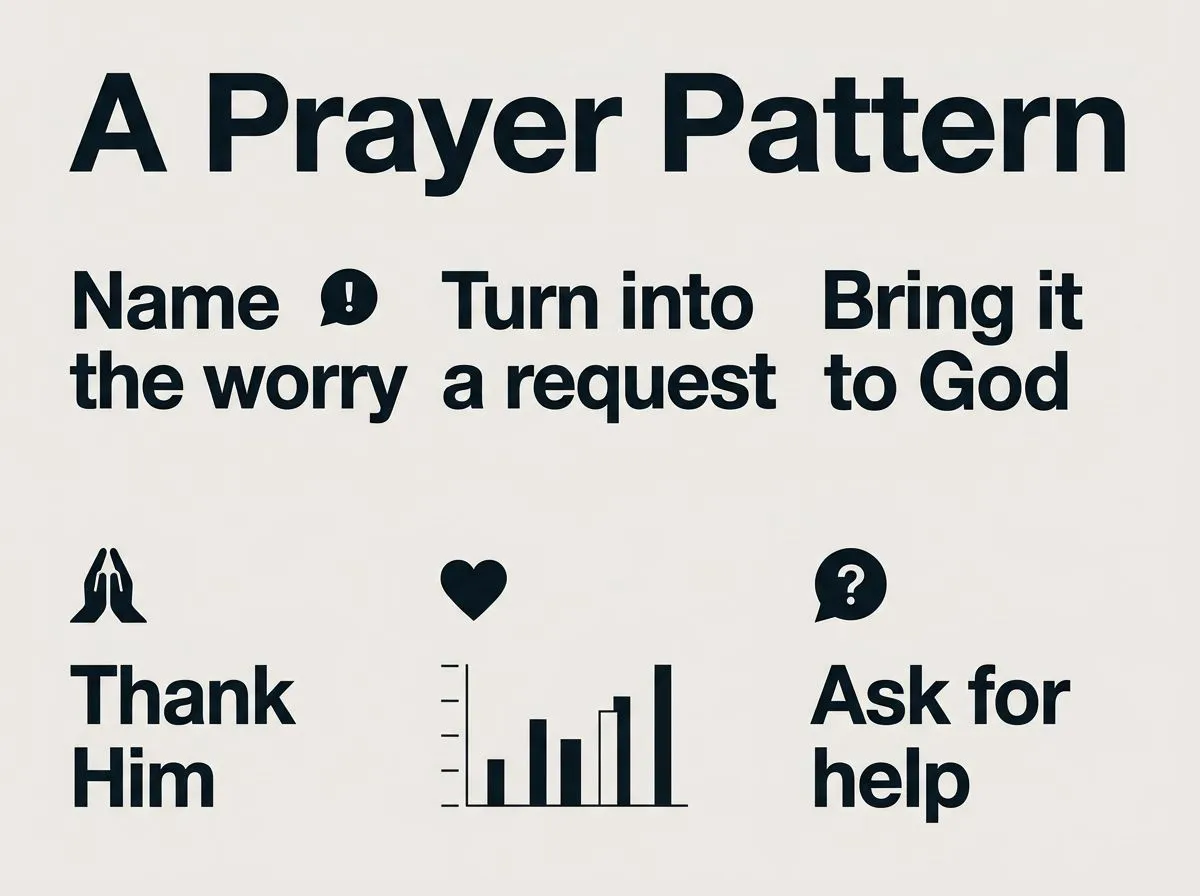
- Name the worry in plain words. Say the exact thing that is pressing on you, such as a bill, a doctor’s appointment, a family conflict, or fear about the future.
- Turn that worry into a request. Ask God for help instead of only circling the fear, and add thanksgiving for what He has already provided and for who He has proven Himself to be.
- Pray Philippians 4:6-7 out loud or quietly. Ask God to guard your heart and your mind through Christ Jesus, especially when your thoughts start to race again.
- Return to the verse daily. Read it in the morning, write it on a card, and come back to it whenever the same worry rises again during the day.
A simple prayer could sound like this: “Father, I am anxious about this situation. I bring it to You now and ask for wisdom, peace, and help. Thank You for caring about me and for being faithful.
Guard my heart and mind through Christ Jesus.” That prayer is honest enough for a tired mind and specific enough to keep your faith from drifting into vague words.
Related Bible verses and when to use each one
Different passages fit different kinds of worry, so the best verse depends on what is loudest in your mind.
Use Philippians 4:6-7 when you need a prayer pattern, Matthew 6:34 when tomorrow is stealing today’s peace, and 1 Peter 5:7 when you need permission to hand the burden over to God.
| Passage | Main focus | How it helps a worried reader | Best use case |
|---|---|---|---|
| Philippians 4:6-7 | Prayer, petition, thanksgiving, and God’s guarding peace | It gives you a direct response to anxiety and a model for praying through it | When your mind is crowded and you need words to pray now |
| Matthew 6:34 | Trust for today instead of fear about tomorrow | It narrows your attention to the day in front of you | When future what-ifs are multiplying in your head |
| 1 Peter 5:7 | Casting care on God because He cares for you | It helps you hand over a burden instead of carrying it alone | When worry feels heavy and personal, and you need release |
| Isaiah 26:3 | Steady peace for the mind fixed on God | It points to the connection between trust and inner stability | When your thoughts keep wandering and you need to refocus |
How Bible study tools can help you read it well
Bible study tools can help you read Philippians 4:6-7 in context, especially if you want to compare translations or see how the verse fits the rest of the chapter.
BibleHub is useful for side-by-side wording, while GotQuestions.org and Enduring Word help explain Paul’s instruction to pray instead of carrying anxiety alone, and his connection between prayer and the peace that guards the mind.
That kind of reading matters because Philippians 4:6-7 is sometimes treated like a slogan, when it is really a linked set of instructions. The verse is clearer when you see Paul’s emphasis on prayer, thanksgiving, and the peace that guards the inner life instead of reading it as a promise that nothing painful will happen.
If you compare translations, you will notice small but meaningful differences in tone. The NIV says “Do not be anxious about anything,” the KJV says “Be careful for nothing,” and the NLT makes the sense very direct with “Don’t worry about anything.”
The wording shifts, but the message stays the same: bring the burden to God, then let His peace do its work.
A simple way to carry this verse through the day
The best way to carry Philippians 4:6-7 through the day is to make it the first prayer you return to when anxiety reappears.
Read it once in the morning, speak one worry to God by name, and repeat the verse before you check messages, start work, or sit down to a hard conversation.
This is not about forcing instant relief, and that honesty matters. Some worries quiet quickly, and some do not. Even so, the verse gives you a faithful place to stand while your feelings catch up to what you are praying.
Let the passage shape your next response rather than your whole life at once. When fear spikes, return to the verse, name the concern, ask plainly, and thank God for His care. That is a small practice, but it is a real act of trust.
If you need one verse to hold onto when your mind is full of worries, make it Philippians 4:6-7. Read it, pray it, and keep bringing the same burden back to God until your heart learns to rest in His care.
Frequently asked questions
Which Bible verse is best for worry and fear?
Philippians 4:6-7 is the clearest starting point because it directly tells you to bring anxiety to God in prayer and then points you to His peace.
It works especially well when your mind feels crowded, because Paul gives you a next step, not just comfort. The verse is written for real pressure, so it fits ordinary fears, strained relationships, and daily trust.
Should I read Philippians 4:6-7 in NIV or KJV?
Use the translation you understand most clearly. The NIV says, “Do not be anxious about anything,” while the KJV says, “Be careful for nothing,” and the wording is different but the meaning is the same.
If you want a very plain reading, the article notes that the NLT is even more direct.
Does Philippians 4:6-7 mean Christians should never feel anxious?
No. Paul is not saying you will never feel anxious, and he is not asking you to fake calm.
He is telling you what to do with the anxiety, bring it to God in prayer, with thanksgiving, instead of carrying it alone.
What is a short prayer based on Philippians 4:6-7?
Lord, I bring You this worry, I thank You for Your care, and I ask You to guard my heart and mind with Your peace through Christ Jesus.
What verse should I read if I am worried about tomorrow?
Matthew 6:34 is the most direct follow-up, because Jesus tells you not to worry about tomorrow and to stay focused on today.
It is the right verse when future what-ifs are taking over your mind, while Philippians 4:6-7 helps you pray through the burden in front of you.


This Bible Verse Can Help You Face a Difficult Day
Psalm 46:1 is a strong Bible verse for a difficult day because it says, “ God is our refuge and strength , a very present help in trouble.” Put simply, God is…

Before Your Next Important Decision, Remember What Proverbs Says
A common mistake is treating Proverbs like a magic formula that guarantees the outcome you want if you quote the right verse. The better way is simpler, and st…

Read This Bible Verse When You're Worried About Your Future
If you’re worried about your future, start with Jeremiah 29:11. It reminds you that God knows your life, sees what you can’t see, and is still working with pur…

This Bible Verse Is a Powerful Reminder of God's Promises
Jeremiah 29:11 is one of the clearest Bible verses about God’s promises: “For I know the plans I have for you, declares the Lord, plans for welfare and not for…