
This Bible Verse Has a Powerful Lesson About Your Family's Future
A family’s future is not secured by perfect planning, and Isaiah 41:10 says that plainly.

Prayer for Your Children’s Future Ask God to guide their path.
READ PRAYER →
You will remain on the same website.
God promises His presence, strength, help, and support to people who are afraid.
That doesn’t mean life gets easy, but it does give your home solid ground when the road ahead feels uncertain.
Key takeaways
- Isaiah 41:10 gives 4 promises in one verse: God is with you, strengthens you, helps you, and upholds you.
- Psalm 37:5 and Philippians 1:6 add 2 more anchors, making this a strong 3-verse framework for family prayer.
- Teach this hope in 1 short habit: read the verse, explain it, and pray it at home during a daily family moment.
- Use the verse in 3 real decisions, prayer, stewardship, and unity, so fear does not shape your home’s direction.
- This passage comforts families in uncertainty, but it does not promise a pain-free path or instant fixes.
The Bible verse that speaks most directly to your family’s future
Isaiah 41:10 is one of the clearest verses for family fears about tomorrow because it speaks directly to fear, weakness, and God’s sustaining hand.
The verse says, “So do not fear, for I am with you... I will strengthen you and help you; I will uphold you with my righteous right hand,” and that is exactly the kind of promise a worried parent, spouse, or grandparent needs to hear.

Psalm 37:5 and Philippians 1:6 reinforce the same hope in a different way. Psalm 37:5 calls you to commit your way to the Lord, and Philippians 1:6 gives confidence that God finishes what He starts.
That matters when you’re praying over a child, a marriage, or a season that hasn’t turned around yet.
What Isaiah 41:10 does promise is God’s nearness and faithful support for your family in the middle of fear.
What it does not promise is that every plan will unfold without pain, delay, or hard choices, so the verse should be read as comfort and direction, not as a guarantee of a trouble-free path.
What Isaiah 41:10 means in its biblical context
Isaiah 41 speaks to God’s people in a season of fear and uncertainty, not to a family living comfortably with every answer already in place.
The comfort in verse 10 flows from who God is, not from how stable the circumstances look, which means the verse is about trust in His character before it is about changing the situation.
That context matters because Scripture often links hope for the future with faithful teaching across generations.
Deuteronomy 6:2, 6:7, and 6:20 show a multi-generational pattern, where God’s people are called to fear the Lord, teach His words diligently, and explain His ways when children ask what they mean.
Exodus 13:14 adds the same family pattern in a vivid way: when a son asks about God’s deliverance, the answer is to tell the story of what the Lord has done.
In other words, family faith is not only private comfort, it is remembered, spoken, and passed down on purpose.
How this verse shapes everyday family decisions
- Prayer: Pray specifically for your children, your marriage, and your family’s direction instead of only asking for vague blessing. Scripture gives you language for clear requests, and that clarity helps you pray with faith instead of worry.
- Stewardship: Make wise decisions with time, money, and responsibilities while trusting God with the outcome. Faith does not replace planning, it keeps planning from becoming panic.
- Unity: Choose patience, forgiveness, and shared worship instead of fear-driven reactions when pressure rises at home. A fearful household often speaks sharply and moves quickly, while a trusting one pauses and listens.
- Hope: Remember God’s faithfulness when family plans feel delayed or uncertain. That perspective keeps discouragement from becoming the loudest voice in the room.
Related passages that reinforce God’s faithfulness to families
| Reference | Main promise | Family-life connection | Best use case |
|---|---|---|---|
| Psalm 127:1 | The Lord builds the house and guards the home | A reminder that family security depends on God’s help, not only human effort | When you feel pressure to hold everything together on your own |
| Proverbs 3:5-6 | God directs the path of those who trust Him | Helpful for family decisions, transitions, and uncertain next steps | When you need guidance about schooling, moves, work, or major family choices |
| Philippians 1:6 | God finishes the good work He starts | A strong encouragement when you are praying for a child’s spiritual growth or long-term family change | When you want confidence that God is still working over time |
| Psalm 37:5 | Committing your way to the Lord brings His guidance | Supports daily surrender in parenting, marriage, and home life | When anxiety makes you want to control the outcome |
What helps you teach this hope at home
The strongest family teaching starts with repetition that is simple enough for children to remember and deep enough for adults to live by.
Isaiah 41:10 becomes practical when it is read, spoken, and tied to ordinary moments like school mornings, a hard phone call, or a quiet prayer at the kitchen table.
Bill High’s discussion of Exodus 13:14 is useful here because it shows the value of answering a child’s question with the story of God’s deliverance, not with a lecture.
That’s a helpful model for modern homes too: when a child asks why you still trust God, you point to what He has done and what He has promised, then you let that truth shape the family atmosphere.
The American Bible Society also emphasizes making time for God’s Word in the home, and that is the practical bridge between belief and habit.
A family that opens Scripture together, even briefly, is more likely to treat hope as something practiced, not something postponed until life gets easier.
How Christians can use this verse with real-world family pressure
Isaiah 41:10 is especially steadying when family pressure shows up in ordinary forms, like a job loss, a move, a teenager pulling away, or a season of financial strain.
In those moments, the verse keeps you from measuring your family’s future by the size of the problem alone.
Families With Grace, Bible Study Tools, and Outreach Magazine all point readers toward Scripture that speaks to family hope, and that is worth noticing because the Bible addresses family fear without pretending it is small.
Jeremiah 31:16-17 is a strong companion passage here, because it speaks of hope for descendants and the return of children, showing that God’s care extends beyond the present moment.
That matters because many parents and grandparents quietly carry the same question: Will God still be at work in my family after I’m gone?
Isaiah 41:10 answers that fear by anchoring the future in God’s own hand, not in the fragility of your control.
Next steps for your family
The next step is to turn this verse from a comfort into a practice, one day at a time. Start small, keep it concrete, and let Scripture shape the tone of your home.
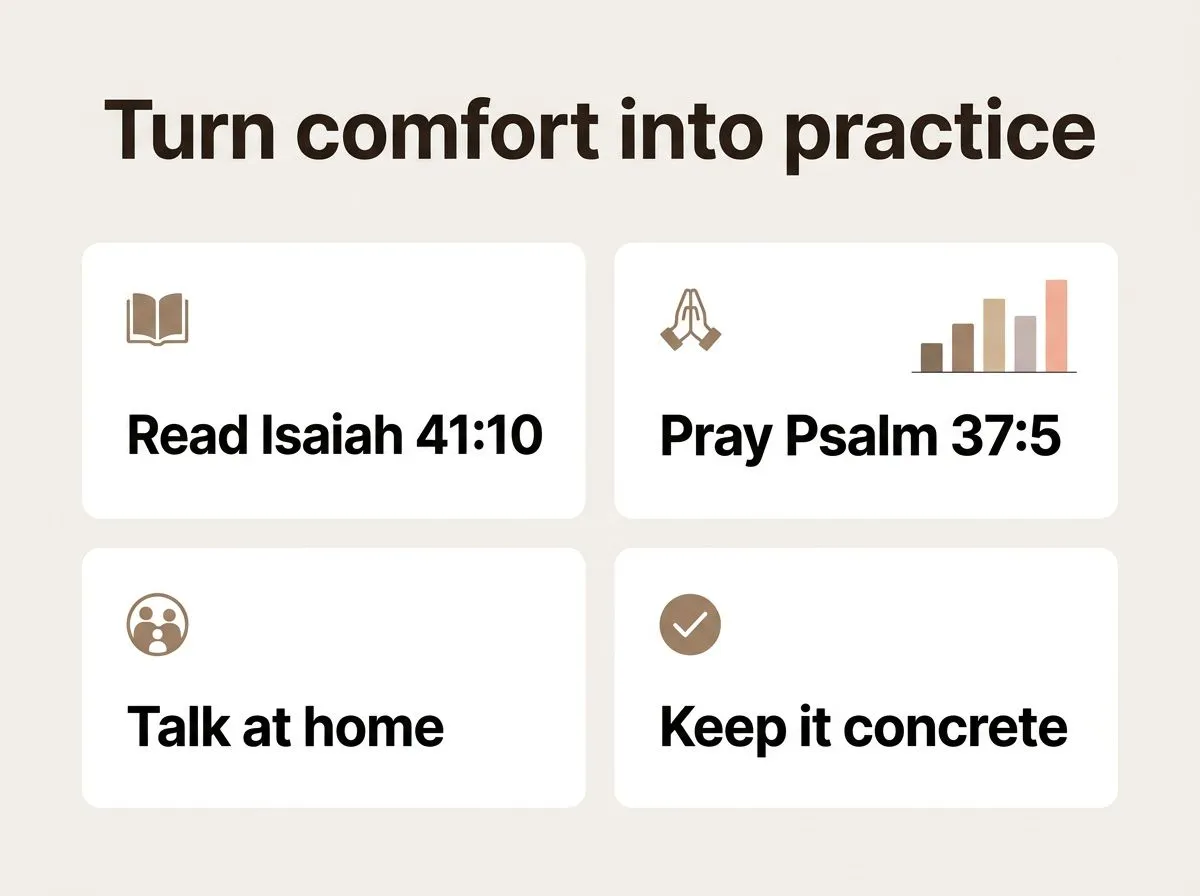
- Read Isaiah 41:10 out loud this week and ask each person in your home what phrase stands out.
- Pray Psalm 37:5 over one specific family concern, such as a decision, a child’s future, or a season of uncertainty.
- Choose one place in your home, like the dinner table or a bedroom door, where you will keep a visible Bible verse for daily reminder.
- Tell one family story this week about a time God helped your household through fear or change.
- Keep praying Philippians 1:6 over the people in your home and trust God to keep working beyond what you can see.
Frequently asked questions
Is Isaiah 41:10 talking specifically about families?
Not directly, but it speaks clearly to God’s people in fear, and that makes it a strong promise to lean on when your family feels anxious about the future.
In context, the verse centers on God’s presence, help, strength, and sustaining hand, not on a problem-free life.
What if I need a verse for a child, not the whole family?
Use passages like Proverbs 22:6 or Exodus 13:14 alongside Isaiah 41:10, because they speak more directly to children and the next generation.
That helps you connect the main promise to raising a child in the faith, not just to general family encouragement.
Can I pray this verse over my family every day?
Yes. You can turn Isaiah 41:10 into a daily prayer for God’s presence, protection, wisdom, and steady guidance over your home.
Many Christians also pair it with Philippians 1:6, asking God to keep working in each family member over time.
Which verse is best if my family is facing uncertainty right now?
Psalm 37:5 and Philippians 1:6 are especially helpful alongside Isaiah 41:10, because they speak to trust and to God finishing what He starts.
Psalm 37:5 is especially good when you need to surrender one specific decision, and Philippians 1:6 brings hope when the change you are praying for is still unfinished.


This Bible Verse Can Help You Face a Difficult Day
Psalm 46:1 is a strong Bible verse for a difficult day because it says, “ God is our refuge and strength , a very present help in trouble.” Put simply, God is…

Before Your Next Important Decision, Remember What Proverbs Says
A common mistake is treating Proverbs like a magic formula that guarantees the outcome you want if you quote the right verse. The better way is simpler, and st…

Read This Bible Verse When You're Worried About Your Future
If you’re worried about your future, start with Jeremiah 29:11. It reminds you that God knows your life, sees what you can’t see, and is still working with pur…

This Bible Verse Is a Powerful Reminder of God's Promises
Jeremiah 29:11 is one of the clearest Bible verses about God’s promises: “For I know the plans I have for you, declares the Lord, plans for welfare and not for…