
7 Powerful Parables of Jesus and Their Meaning
Jesus’ parables are short stories with a spiritual point, and they matter because Jesus used them to reveal God’s truth in a way His listeners could understand, while also exposing hardened hearts. If you want to read them well, stay close to the passage, the setting, and the main message, instead of turning every detail into a secret code.
Key takeaways
- Jesus used 7 parables here to reveal God’s truth through familiar scenes, not secret codes.
- The Sower, Good Samaritan, and Prodigal Son each point to one clear response: receive, love, and return.
- First listeners heard these stories in a real-world setting, so the details mattered within the passage, not apart from it.
- The Kingdom parables show that small beginnings can still lead to lasting growth and costly joy.
- The safest way to read a parable is to stay close to the text, the setting, and the main message.
Why Jesus Used Parables
A parable is a short story Jesus used to teach spiritual truth through familiar images from everyday life. He spoke about seed, soil, bread, banquets, wages, coins, and neighbors because those were the kinds of scenes people in Galilee and Judea knew well.
Matthew 13:10-17, Mark 4:10-12, and Luke 8:9-10 explain why Jesus taught this way: the truth was given to those willing to hear, but it remained hidden from the hard-hearted. That tension matters, because parables are not puzzles meant to be solved for sport, they are calls to listen with humility.
This is why the safest rule is simple, stay close to the context and do not make every detail stand for something else. Kathy Howard warns that parables are symbolic to a degree, but not full allegories, and that the context gives the clues Kathy Howard.
7 Powerful Parables of Jesus and Their Meaning

| Parable name | Bible passage | Original audience/context | Main meaning from the text | Everyday Christian application |
|---|---|---|---|---|
| The Sower | Matthew 13:1-23; Mark 4:1-20; Luke 8:4-15 | Jesus taught beside the Sea of Galilee, where planting and rocky ground were common sights | The condition of the heart determines how the word of God is received | Listen with repentance, and ask God to make your heart good soil |
| The Good Samaritan | Luke 10:25-37 | A lawyer asked Jesus what it means to love one’s neighbor | True neighbor love crosses social and ethnic boundaries and shows mercy in action | Help the person in front of you, even when it costs time or comfort |
| The Prodigal Son | Luke 15:11-32 | Jesus was answering criticism from people upset that He welcomed sinners | The Father welcomes repentant sinners, and self-righteousness also needs correction | Return to God quickly, and refuse bitterness when grace is given to others |
| The Lost Sheep | Matthew 18:12-14; Luke 15:3-7 | Jesus spoke to people who needed to hear God’s heart for the wandering | God actively seeks the one who is lost | Do not treat anyone as too far gone to be reached by mercy |
| The Mustard Seed | Matthew 13:31-32; Mark 4:30-32; Luke 13:18-19 | Listeners knew how small seeds could become useful plants | God’s Kingdom begins small but grows beyond expectation | Do not despise small beginnings in your own obedience |
| The Hidden Treasure | Matthew 13:44 | Jesus described the Kingdom to crowds hearing many kingdom parables | The Kingdom of Heaven is worth joyful sacrifice | Treat Christ’s reign as your greatest gain, not a side interest |
| The Pearl of Great Price | Matthew 13:45-46 | Jesus again pictured the Kingdom with a costly purchase | The Kingdom is worth everything you have | Count following Jesus as a treasure, not an accessory |
| The Unforgiving Servant | Matthew 18:21-35 | Jesus answered Peter’s question about forgiveness | Those forgiven much must forgive others | Let God’s mercy shape the way you respond to offense |
What These Parables Meant to Jesus’ First Listeners
These parables were vivid because they came out of ordinary first-century life, including farming, travel, debt, hospitality, wages, and village relationships. Biblical Archaeology Society notes that Jesus’ parables are tied closely to their ancient setting, and The Gospel Coalition says the original force of the stories can be hard to recover because modern readers are so familiar with them Biblical Archaeology Society, The Gospel Coalition.
That setting often sharpened the challenge. A story about a Samaritan helping a wounded man was not just a lesson in kindness, it confronted ethnic prejudice. A story about a father running to receive a son was not just warm family language, it unsettled people who expected shame to be the final word.
Jesus also used these stories to confront assumptions about who belonged in God’s Kingdom and what faithfulness looked like. In other words, the crowd did not only hear moral advice, they heard a judgment on their values, their pride, and their reading of Scripture.
That is why the emotional effect mattered as much as the plot. Some listeners would have felt surprise, some discomfort, and some conviction, because the stories made room for mercy while exposing self-importance.
How to Live Out the Parables of Jesus Today
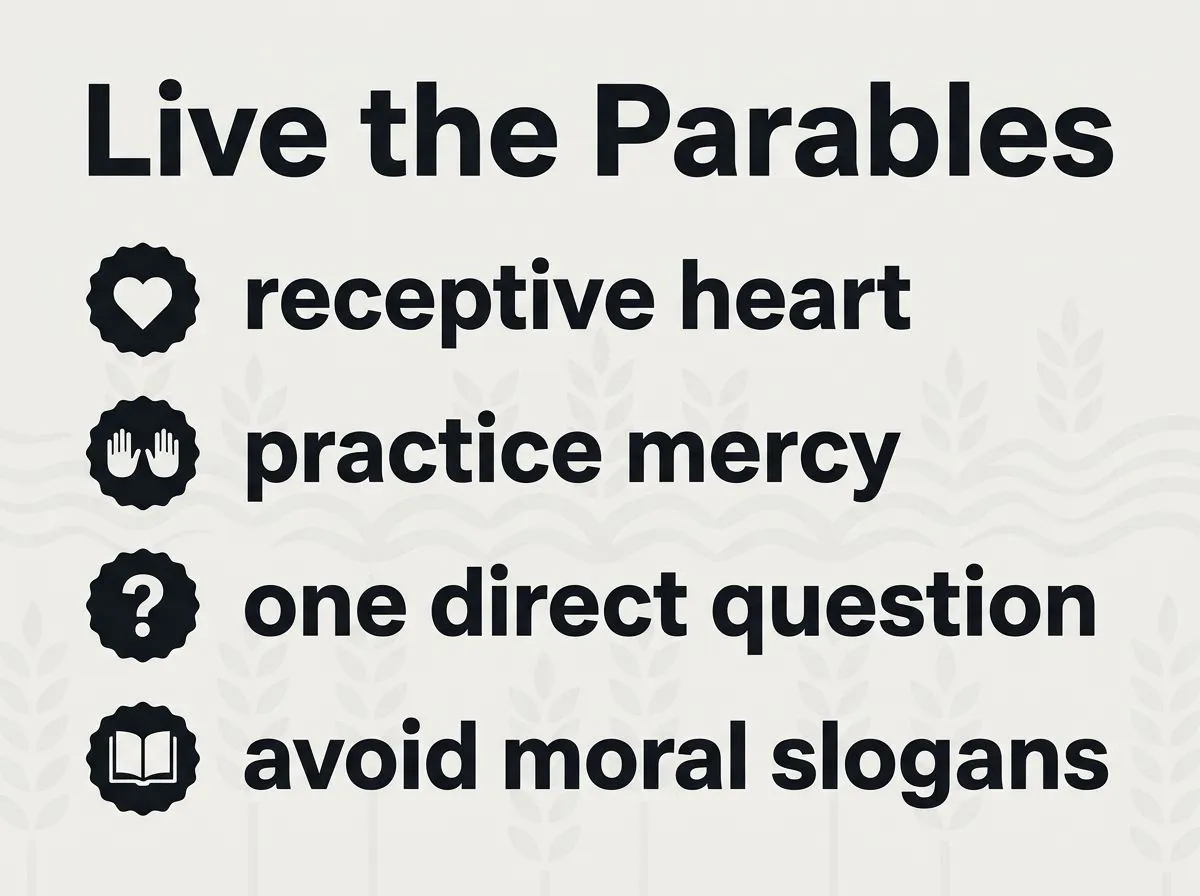
- Hear the word with a receptive heart. The Sower asks you to examine what kind of soil you are becoming in prayer, worship, and obedience.
- Practice mercy across boundaries. The Good Samaritan calls you to notice need before you notice inconvenience.
- Come home to the Father quickly. The Prodigal Son invites repentance without delay and trust in God’s welcome.
- Celebrate the lost being found. The Lost Sheep reminds you that God values the wandering and that you should too.
- Treat small acts of faithfulness as seed, not failure. The Mustard Seed says God can grow what starts tiny and overlooked.
- Give Jesus your highest loyalty. The Hidden Treasure and the Pearl of Great Price ask you to measure every other gain against the Kingdom.
- Forgive from the mercy you have received. The Unforgiving Servant shows that grace accepted must become grace extended.
How to pray with these parables
Ask one direct question after reading: Lord, what in this story is exposing my heart, correcting my habits, or calling me to trust You more? That keeps the parables from becoming religious wallpaper and turns them into a living conversation with Jesus.
A common mistake is to treat them as short moral slogans. They are more than useful sayings, because each one presses you toward a response to Jesus Himself, not merely admiration for wise teaching.
If you study them with others, use one passage at a time and stay with the main point before moving to applications. The ESV Study Bible is often used for close reading of Scripture, and that kind of disciplined reading helps prevent speculative interpretations ESV Study Bible.
What to notice when you read the parables again
Look for the person in need, the surprising reversal, and the response Jesus expects. Those three things will usually tell you more than a dozen guesses about hidden symbols.
Bible Study Tools and Christianity.com both present the parables as relatable stories that use the familiar to explain deeper truth, which is exactly why they work so well for ordinary Christian reading Bible Study Tools, Christianity.com.
When a detail is clear from the text, receive it. When a detail is not explained, do not force it. That restraint keeps you from missing the very thing Jesus meant to make plain.
Next Steps for Reading Jesus’ Parables
- Read one parable in its full Gospel context, not as a standalone saying.
- Write down the main point in one sentence after reading.
- Ask how the story exposes your heart, your habits, or your view of God.
- Choose one concrete act of obedience that matches the parable you read.
- Return to the same passage in prayer during the week and ask Jesus to make the meaning real in your life.
Frequently asked questions
How many parables did Jesus teach in the Gospels?
The exact count depends on how you classify related sayings and short stories, but the Synoptic Gospels preserve a large body of parables, and many Bible study resources place them at around 30 to 40 distinct teachings. This article highlights seven of the best-known ones, including the Sower, the Good Samaritan, and the Prodigal Son.
What is the difference between a parable and an allegory?
A parable is usually a short story with one main spiritual point, while an allegory maps many details to many meanings. Jesus sometimes used symbolic details, but the safest reading is to stay close to the context and let the text itself show which details matter.
Why did some people not understand Jesus’ parables?
Jesus said the parables revealed truth to those willing to hear, but they remained obscure to hardened hearts. The issue was not only intelligence, but openness to His message, and that is why the same story could convict one listener and confuse another.
Should every detail in a parable be interpreted spiritually?
No. Some details simply support the story without carrying a separate hidden meaning, and forcing them can lead you away from Jesus’ point. Let the surrounding passage, Jesus’ own explanation when He gives one, and the main thrust of the story guide your interpretation.


The Life of Jesus Christ: From His Birth to Resurrection
See how Matthew, Mark, Luke, and John trace Jesus from birth to the empty tomb, and why the differences matter.

What Jesus Taught About Forgiveness and Second Chances
Jesus ties forgiveness to mercy, repentance, and love for enemies. Learn how His teaching shapes real forgiveness and wise boundaries.

What Jesus Taught About Faith, Trust, and Believing in God
Jesus teaches faith as personal trust in Him. Learn what that means, how it differs from works, and how to live it daily.

What Jesus Taught About Love: Lessons for Everyday Life
Jesus taught love as sacrifice, obedience, and action. Learn how that shapes your words, choices, and relationships each day.