
The Life of Jesus Christ: From His Birth to Resurrection
The four canonical Gospels give you one clear story from different angles. Matthew and Luke include the birth narratives, Mark opens with John the Baptist and Jesus’ baptism, and John begins with the Word made flesh. Read together, they trace Jesus from Bethlehem and Nazareth to Jerusalem, then to the cross and the empty tomb. This guide shows how the accounts fit, where they differ, and why those differences matter.
Key takeaways
- Matthew and Luke include Jesus’ birth narratives, while Mark begins with John the Baptist and John starts with the Word made flesh.
- Jesus’ public ministry begins after His baptism, then moves through Galilee, Judea, and Samaria before the final journey to Jerusalem.
- The crucifixion is the center of the Gospel story, not a detour, and the resurrection is presented as a real event, not a symbol.
- The four Gospels agree on the main events, but each writer emphasizes different details, so one account can fill gaps left by another.
How the four Gospels begin the life of Jesus
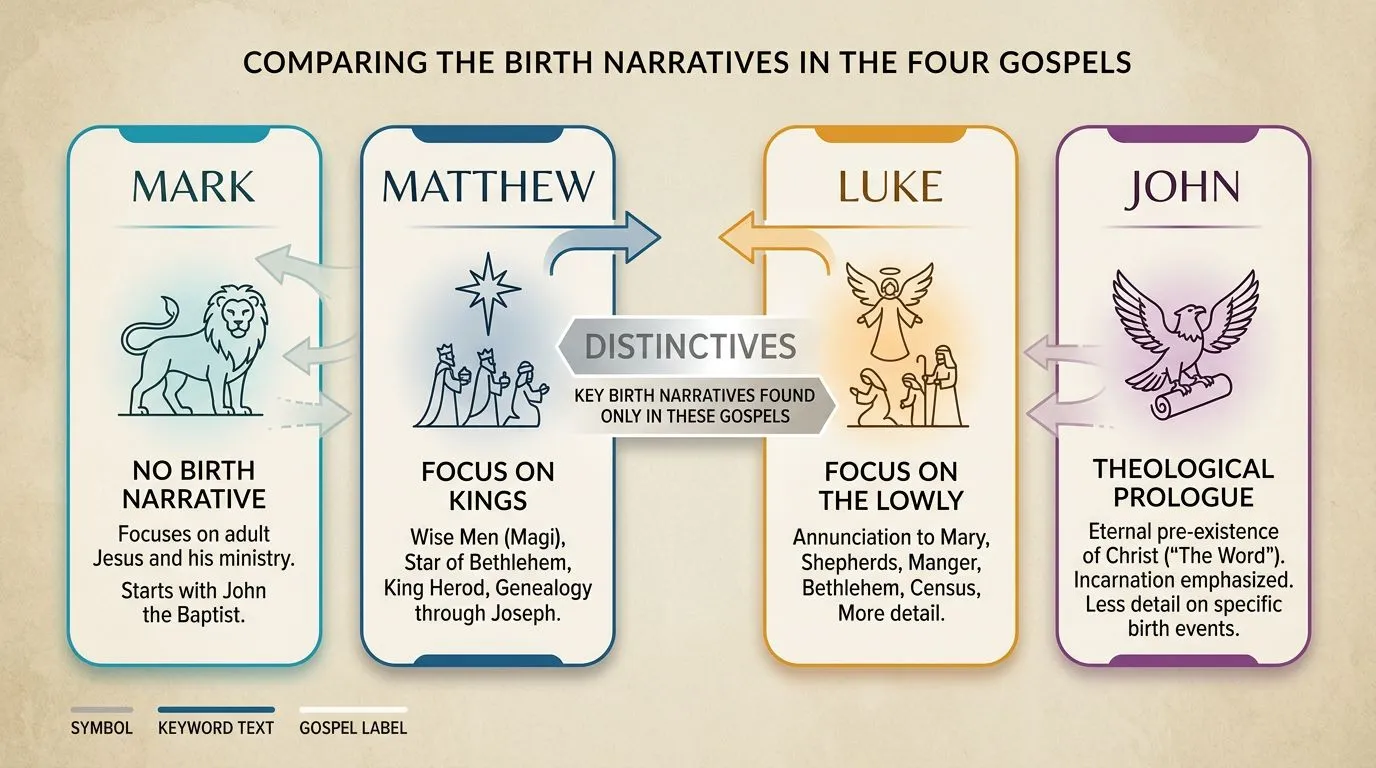
| Gospel | Birth narrative? | People and places included | Key events highlighted | Distinctive emphasis |
|---|---|---|---|---|
| Matthew | Yes | Mary, Joseph, Bethlehem, the Magi, Herod, the child Jesus | Genealogy, annunciation to Joseph, birth in Bethlehem, visit of the Magi, flight to Egypt, return to Nazareth | Fulfillment of prophecy and Jesus as the promised Messiah |
| Mark | No | John the Baptist, Jesus, the Twelve Apostles | Opens with John preaching in the wilderness, then Jesus’ baptism and ministry | A direct opening on Jesus’ public mission |
| Luke | Yes | Mary, Joseph, Bethlehem, shepherds, angels, John the Baptist, Simeon, Anna | Annunciation to Mary, census setting, birth in Bethlehem, shepherds, temple scenes, early childhood notes | A careful, ordered account that highlights joy, humility, and the wideness of God’s care |
| John | No birth scene, but a theological beginning | The Word, John the Baptist, Jesus, His first followers | Opens with the Word made flesh, then John the Baptist’s witness and the start of public ministry | Focus on Jesus’ divine identity from the first line |
Matthew and Luke are the two Gospels that tell you where Jesus was born and who was around Him, while Mark moves straight to public ministry and John starts even earlier, with Jesus’ identity before the manger. That matters because the Gospels are not trying to squeeze every detail into one script. They show the same Lord from four faithful angles, and each writer chooses details that serve his own purpose.
Matthew places the story inside the language of promise and fulfillment. He connects Jesus to Israel’s hope, includes the visit of the Magi, and shows how danger from Herod pushes the family toward Egypt before they settle in Nazareth. Luke gives the clearest family and temple scenes, including the shepherds, the angels, and the early glimpses of Jesus’ life among ordinary people in Bethlehem and Nazareth. John, by contrast, gives no cradle scene at all. He wants you to see, right away, who Jesus is.
The timeline of Jesus’ ministry across the Gospels
- Jesus’ public ministry begins with John the Baptist preparing the way and baptizing Jesus, which the Gospels present as the turning point into Jesus’ public work.
- Jesus is then tempted in the wilderness, a short but decisive episode that comes right after the baptism and before the public preaching expands.
- From there, Jesus calls disciples, teaches crowds, heals the sick, casts out demons, and performs miracles as He moves through Galilee, Judea, and Samaria.
- The story narrows toward the final Passover journey to Jerusalem, where opposition hardens, the leaders move against Him, and the passion narrative takes over.
That sequence gives you the skeleton of the Gospels. The baptism is not a private spiritual moment tucked away from the rest of the book. It is the public start of Jesus’ ministry, with John the Baptist serving as the forerunner who points away from himself and toward the coming Messiah. Once Jesus begins preaching the kingdom of God, the pace changes. He is not staying in one village. He is moving, teaching, calling, and confronting.
The route matters too. Jesus’ ministry is not confined to one city block or one temple court. The Gospels show Him working across Galilee, Judea, and Samaria, which helps explain why different readers remember different episodes. One Gospel may linger over a sermon, another over a healing, another over a meal or a journey. The final movement into Jerusalem gives the whole ministry a clear direction: Jesus is heading toward the place where His mission will be completed.
What the Gospels affirm about the crucifixion and resurrection
The crucifixion is the hinge of the Gospel story, the moment every account has been moving toward. The writers do not present Jesus’ death as an accident that interrupted His mission. They present it as the center of it. Matthew’s account treats the cross as the collapse of human power and the advance of God’s rule, while the wider New Testament, including the Pauline epistles, keeps returning to the meaning of Jesus’ death and resurrection as the ground of Christian hope Theology of Work.

The resurrection is affirmed in the Gospels as a real event, not a symbol for inner renewal. The tomb is empty, and Jesus appears to His followers alive. That is why the story does not end with grief at the grave.
It moves to recognition, worship, and commission. The risen Jesus meets His friends, and their fear turns into witness. For Christian faith, that shift is everything: forgiveness is not based on a memory of a noble death alone, but on the claim that Jesus rose bodily from the dead and lives Cru.
That is also why resurrection hope is not vague optimism. It is tied to Jesus Himself. The Gospels and the Acts of the Apostles move from the empty tomb to the spread of witness, because the risen Christ does not remain a private comfort. He becomes the living Lord who sends His followers out. If you read the resurrection only as metaphor, you miss the force of the text. The writers mean to say that death did not win.
Where the Gospel accounts align and where they differ
The four Gospels agree on the core arc: Jesus begins His ministry after John the Baptist, He teaches and heals, He goes to Jerusalem, He is crucified, and He is raised. That shared backbone is strong enough that no responsible reading can turn the Gospels into four unrelated biographies. The same Jesus stands at the center of all four accounts, and the same saving events hold them together.
The differences begin with the opening scenes. Matthew and Luke give nativity material, but they choose different details and settings. Matthew emphasizes Joseph, the Magi, Herod, and the fulfillment of Scripture. Luke emphasizes Mary, the shepherds, the angelic announcement, and the temple-centered early life. Mark skips the infancy story altogether, and John starts with a theological prologue instead of a cradle narrative. Those are not contradictions to erase. They are angles to read carefully.
The ministry material also varies in amount and sequence. Some episodes appear in all three Synoptic Gospels, while John includes a different selection of signs, conversations, and festival scenes. The result is not confusion if you read with patience. It is a fuller portrait. One Gospel may slow down at a mountain sermon, while another moves faster toward the Passion Week. The reader’s mistake is to demand that every account tell the story in the same order and with the same level of detail.
Responsible harmonization keeps two truths together. Shared truth says the events really happened and belong to one life. Distinct emphasis says each Gospel writer shaped his account for a real purpose and audience. If you force every scene into one rigid sequence, you can flatten the witness. If you ignore the differences, you miss why Matthew sounds like Matthew, Luke sounds like Luke, Mark sounds like Mark, and John sounds like John. Read them together, and the life of Jesus Christ becomes clearer, not weaker.
The most practical way to read the four accounts is to let each one speak on its own terms first, then set it beside the others. Matthew helps you see fulfillment. Mark helps you see urgency. Luke helps you see compassion and order. John helps you see Jesus’ identity and glory. Put them together, and you get a Gospel-shaped picture of the birth, ministry, death, and resurrection of Jesus that is solid for faith and clear for daily reading.
If you want the simplest takeaway, keep this in mind: the Gospels are not competing stories about Jesus Christ, they are complementary testimonies. Read Matthew for promise, Mark for motion, Luke for detail, and John for meaning. Then read them again in light of the cross and the empty tomb, because that is where the whole life of Jesus points.
Frequently asked questions
Why do Matthew, Mark, Luke, and John tell the life of Jesus differently?
Each Gospel writer selects and arranges material for a purpose, so the differences usually reflect emphasis, audience, and theological focus rather than contradiction. Matthew leans into promise and fulfillment, Luke gives you a more ordered family-and-temple picture, Mark moves quickly into public ministry, and John starts with Jesus’ divine identity. Read together, they give a fuller portrait of one Lord.
Which Gospel gives the most detail about Jesus’ childhood?
Luke gives the fullest childhood material, with the clearest family and temple scenes, while Matthew adds key birth and early-flight details. Luke includes the shepherds, angels, Simeon, Anna, and brief notes about Jesus growing up in Bethlehem and Nazareth, while Mark begins with Jesus’ ministry and John opens with a theological prologue.
Do all four Gospels describe the same resurrection appearances?
They overlap on the empty tomb and post-resurrection appearances, but each Gospel highlights different witnesses and moments. The shared center is the same, Jesus is raised and appears alive, but the writers choose different scenes so you see the event from several faithful angles rather than one flattened retelling.
Why is Jerusalem so important in the final part of Jesus’ life?
Jerusalem is important because it is where the Passover events, crucifixion, burial, empty tomb, and resurrection appearances all come together. The final movement into the city gives the whole story direction, since Jesus is heading to the place where His mission reaches its climax.
How should a reader handle small differences in the Gospel accounts?
Read them as complementary eyewitness-style accounts, notice the shared core events first, then compare the details each writer chose to stress. The healthy habit is to let each Gospel speak on its own terms, instead of forcing every scene into one rigid sequence or treating different emphasis as a problem.


What Jesus Taught About Forgiveness and Second Chances
Jesus ties forgiveness to mercy, repentance, and love for enemies. Learn how His teaching shapes real forgiveness and wise boundaries.

What Jesus Taught About Faith, Trust, and Believing in God
Jesus teaches faith as personal trust in Him. Learn what that means, how it differs from works, and how to live it daily.

What Jesus Taught About Love: Lessons for Everyday Life
Jesus taught love as sacrifice, obedience, and action. Learn how that shapes your words, choices, and relationships each day.
The Miracles of Jesus and What They Teach Us About Faith
Jesus’ miracles are signs that reveal who He is and call you to trust Him. See what they teach about faith, compassion, and hope.