
How to Distance Yourself From People Who Harm Your Spiritual Life
How do you distance yourself from people who harm your spiritual life? Start with Scripture, set clear limits, and guard your peace without letting your heart grow hard. The Bible supports wise caution when trust is abused again and again, and it still calls you to stay gentle, truthful, and forgiving.
Key takeaways
- Set 1 clear boundary at a time, then keep it short and calm, instead of explaining yourself for 20 minutes.
- Forgiveness and access are not the same, so you can release bitterness without restoring trust right away.
- If a pattern keeps damaging worship, peace, or obedience, reduce contact now and reassess after real change appears.
- Seek outside counsel when the relationship feels controlling, spiritually heavy, or hard to judge honestly.
What the Bible says about harmful relationships and discernment
Matthew 7:6 warns you not to keep placing what is holy before people who repeatedly despise it, which means trust should not be handed back to someone who keeps rejecting truth and misusing care.
Jim Daly of Focus on the Family applies that passage to toxic people who resent correction and turn good intentions against you, and he points to Jesus, who often let hostile people walk away instead of chasing them.
That’s a helpful pattern when you’re trying to tell the difference between a difficult person and someone who is consistently harmful.
2 Timothy 2:24-26 keeps your posture gentle, patient, and truthful at the same time. You are not called to attack, shame, or win every argument; you are called to speak with steadiness while recognizing that some people are trapped in destructive behavior and aren’t ready to receive correction. Jake Kail Ministries uses that passage to frame boundaries as biblical, especially when someone uses pressure, intimidation, or hypocrisy to stay in control.
That’s why the search phrase toxic people Bible keeps showing up in Christian conversations. The label can help you name a pattern, but discernment matters more than the label itself, because not every hard person is unsafe, and not every conflict means you should cut ties. The question is whether the relationship keeps pulling you away from worship, truth, obedience, and peace.
Jesus did not treat every hostile encounter the same way, and that matters. According to Focus on the Family, He repeatedly invested in people who were open, while allowing others to walk away when they were closed off. That doesn’t mean you become cold; it means you stop confusing endless availability with love.
How to set Christian boundaries without abandoning forgiveness
Name the exact limit you need, such as reducing contact, ending disrespectful conversations, or pausing a shared responsibility. A boundary works best when it’s concrete, because vague limits invite debate and keep you stuck in the same emotional loop.
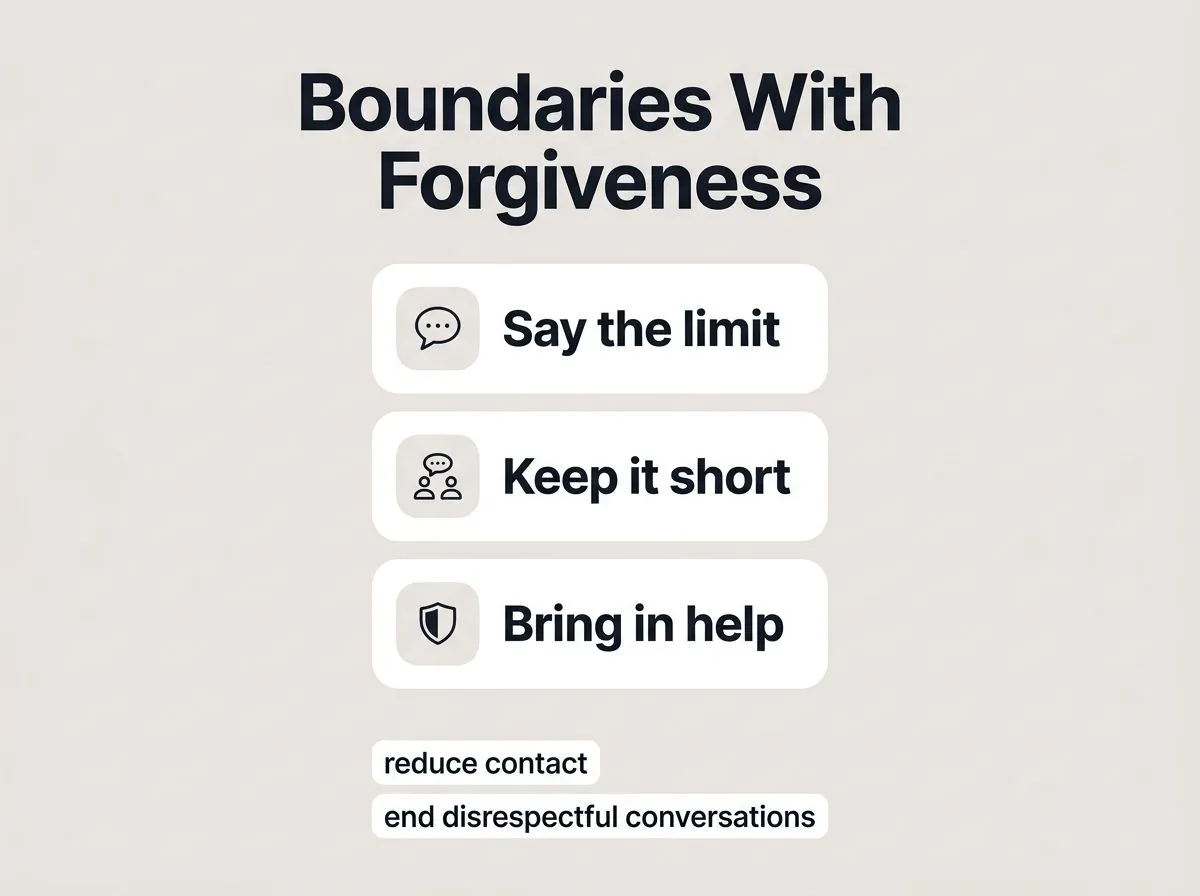
Say the limit in plain language and keep it short. You do not need a courtroom-level explanation, and you do not need to defend your conscience for twenty minutes; one calm sentence is usually enough: “I am not continuing this conversation when I am being mocked,” or “I will not meet one-on-one right now.”
Bring in a trusted pastor, counselor, or mature Christian when the situation feels confusing, spiritually heavy, or emotionally charged. iBelieve recommends talking to someone you trust, preferably a counselor or Christian leader, because outside perspective can help you separate guilt from conviction and fear from wisdom.
Keep forgiveness in place while you reduce access. Forgiveness means you release bitterness and leave revenge to God, but it does not mean you hand back the same closeness, trust, or responsibility that was misused before repentance shows up in real behavior.
That distinction protects you from a common mistake: calling every distance unloving. Sometimes the most loving response is to stop feeding a pattern that keeps injuring your spirit, while still praying for the person and staying open to reconciliation if they genuinely change.
Common harmful relationship patterns and how believers should respond

| Pattern or behavior | What it looks like | Biblical response | Boundary to set | When to seek help |
|---|---|---|---|---|
| Manipulation or guilt pressure | Twisting your words or making you feel selfish for saying no | Speak truth without arguing endlessly | Shorten conversations and repeat your limit once | When the pattern becomes controlling or escalates |
| Repeated disrespect or contempt | Mocking your faith, values, or convictions | Step back from what keeps hardening your heart | Reduce contact and avoid private emotional access | When the hostility affects your peace, worship, or family life |
| Unrepentant wrongdoing | Apology without change | Require fruit, not promises | Withhold trust and shared responsibility | When the behavior is harmful, unsafe, or ongoing |
| Spiritual confusion or pressure | Using Scripture to control you or keep you compliant | Test the fruit and seek wise counsel | Pause the discussion and bring in a pastor or counselor | When you feel trapped, afraid, or unable to think clearly |
These patterns matter because they show you what distance is for. It is not a punishment tool and it is not a dramatic exit; it is a protection step when repeated behavior keeps damaging your conscience, your prayer life, or your ability to think clearly.
The hardest part is usually the reaction after you set the limit. Jake Kail Ministries notes that destructive people often answer boundaries with accusations like selfishness, judgment, or pride, so do not let their outrage define whether your boundary is right. A loud reaction is not the same thing as repentance.
If you’re dealing with someone who claims faith but uses it as a lever, pause the conversation before it pulls you deeper into confusion. A faithful Christian response is not to surrender discernment in order to keep the peace, especially when peace is only being offered at the cost of truth.
Verification checklist
- The boundary must be specific enough to say in one sentence, such as reduced contact, no private meetings, or no disrespectful conversation.
- The other person’s response must show either respect for the limit or a clear pattern of resistance.
- A trusted pastor, counselor, or mature Christian must have reviewed the situation if the relationship feels emotionally or spiritually heavy.
- Your prayer life, worship, and sense of clarity must be more protected after the boundary than before it.
Frequently asked questions
Does forgiving someone mean I have to keep letting them hurt me?
No. Forgiveness releases bitterness and leaves revenge to God, but it does not require ongoing access, trust, or closeness. If the person keeps rejecting correction, you can forgive them and still step back to protect your prayer life, peace, and obedience.
What if the person is a family member or church leader?
The same wisdom still applies, even when the relationship carries family loyalty or spiritual authority. Honor does not mean unlimited exposure, and if the person uses pressure, intimidation, or hypocrisy, outside counsel from a pastor, counselor, or mature Christian can help you see clearly.
How do I know whether I should distance myself or just speak more clearly?
Start with a specific boundary and watch what happens next. If the behavior changes, that may be enough; if it repeats, escalates, or turns manipulative, distance is likely the wiser step. The key question is whether the relationship keeps pulling you away from worship, truth, obedience, and peace.
What if I feel guilty for setting limits as a Christian?
Guilt is common, but boundaries are not sin when they protect what is spiritually healthy. A calm, specific limit can be a faithful response when someone keeps harming your conscience, your prayer life, or your ability to think clearly. What matters is whether the boundary leads to greater clarity and peace, not whether it pleases everyone.


A Letter From Jesus to You
Maybe you arrived here carrying thoughts that no one else knows about. Maybe everything seems fine on the outside, but inside, a battle is taking place. There…

Jesus Has a Word for Your Heart Today
Maybe you arrived here carrying thoughts that no one else knows about. It could be a concern about your family, an important decision, a financial struggle, or…

7 Promises From God for Difficult Times
Seven promises to pray in hard seasons, with clear context so you can trust God’s Word without misreading it.

A Practical Guide to Reading the Gospels
Read one Gospel at a time, keep sessions short, and notice each writer’s purpose so Jesus’ words stay clear.