
Prayer for Healing: Ask God for Strength and Comfort
What is a prayer for healing, and how do you pray it in a way that feels faithful and practical?
A prayer for healing is a Christian prayer that asks God for relief, strength, peace, and restoration in body, mind, or spirit, while still honoring the wisdom to seek medical care when needed.

Prayer for Strength. For difficult times.
Messages, Bible studies, and Christian resources to bring God's Word closer to real life.
VIEW TODAY'S WORD →*You will remain on the same website.
It is for sickness, pain, fear, and grief, and it does not promise a guaranteed outcome.
Key takeaways
- Use 4 simple prayer steps: name the need, ask boldly, lean on Scripture, and end in surrender.
- Keep urgent care in mind, because chest pain, trouble breathing, stroke signs, severe bleeding, or confusion need immediate medical attention.
- Choose 5 Scripture anchors for healing, including Philippians 4:6-7, Psalm 103:2-3, James 5:14-15, Isaiah 41:10, and Psalm 147:3.
- Pray a short healing prayer today, then follow treatment, rest, and medical advice instead of waiting passively.
- Use one of 3 short prayers for yourself, a loved one, or recovery, then keep praying through the day.
What a prayer for healing is, and which Bible verses support it
A prayer for healing is a direct request to God for help when pain, illness, anxiety, or spiritual burden feels heavy.
Scripture supports that kind of prayer in several places: Philippians 4:6-7 points you toward prayer instead of worry, Psalm 103:2-3 remembers God who forgives and heals, James 5:14-15 connects prayer with care for the sick, Isaiah 41:10 calls you to trust God’s strength, and Psalm 147:3 says He heals the brokenhearted and binds up wounds.
Those verses matter because they give you language when your own words feel thin. You do not have to perform for God, and you do not need polished wording.
Simple Bible-based prayers are often gathered in Christian resources such as the Xavier University Jesuit Resource, Bible Study Tools, and Crosswalk, which can help you find wording that stays close to Scripture.
This article is about Christian prayer for healing, not a substitute for a medical diagnosis or treatment plan. Prayer can hold your fear, but it should not be used to ignore symptoms that need care.
How to pray for healing step by step
You can pray for healing in four clear steps: name the need, ask boldly, lean on Scripture, and end in surrender. Keep it plain. God does not need formal language, but you do need words that match what is actually happening.
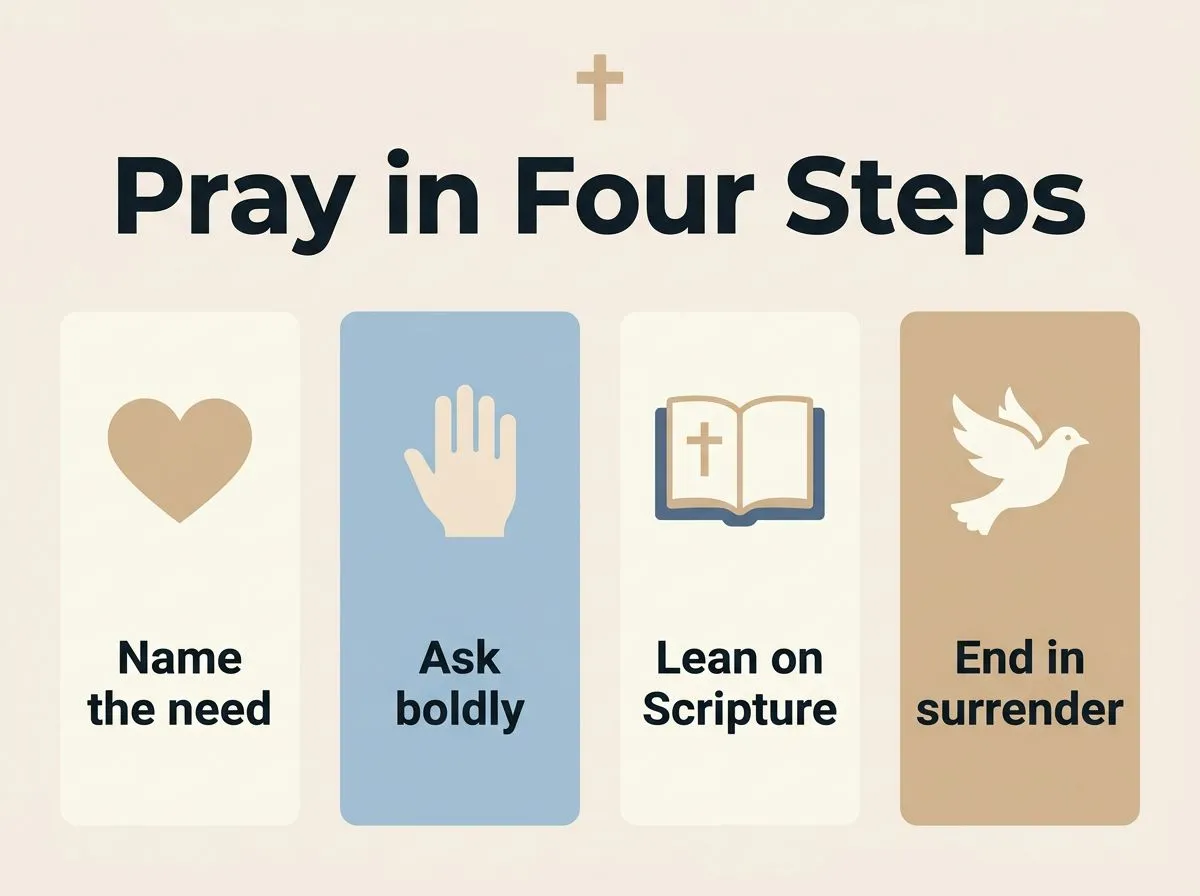
- Name the illness, pain, fear, or loss plainly before God. Say what hurts, where it hurts, and what you are afraid of instead of speaking in vague generalities.
- Ask for healing, strength, peace, wisdom for doctors, and patience for the waiting. Bring the whole need, not only the physical symptom.
- Use Scripture in the prayer as a faith anchor. Philippians 4:6-7 and James 5:14-15 are especially helpful when you feel anxious, weak, or unsure what to say.
- Close with surrender to God’s will and, if needed, ask for comfort for family members or caregivers who are carrying this burden with you.
A simple prayer pattern you can use right now
Start like this: “Lord, I bring You my sickness and my fear. Please heal my body, calm my mind, and give me peace.” Then add the details that fit your situation, such as treatment, rest, or a long recovery.
If you want a Scripture-shaped ending, you can pray, “God, I will not be anxious but will bring this to You in prayer, trusting Your peace to guard my heart and mind.” That keeps the prayer grounded in Philippians 4:6-7 without turning it into a speech.
When to follow medical guidance alongside prayer
You should seek medical care when symptoms are serious, worsening, or persistent, because prayer and professional treatment belong together, not in competition.
The CDC and the U.S. National Library of Medicine are reliable places to check symptom guidance and urgent warning signs, especially when you are unsure whether something can wait.

That means prayer can go with a doctor visit, testing, medication, rest, and follow-up care. It can also help you stay steady while you wait for results. It should not be used as a replacement for a licensed clinician when the problem is beyond home care.
The medical literature has also examined healing prayer in a scientific context. A review in PMC2802370 discusses prayer and healing in relation to clinical study, which shows the topic is taken seriously in research, but research about prayer does not replace the need for clinical guidance when your symptoms raise concern.
Urgent signs you should not pray through at home
You should get urgent care right away for chest pain, trouble breathing, signs of stroke, severe bleeding, confusion, or any symptom that feels life-threatening.
If you are not sure, call emergency services or go to the nearest emergency department instead of waiting for the issue to pass.
A good rule is simple: if the symptom is getting worse fast, feels different from your usual pain, or keeps you from normal activity, do not delay. Pray, yes, but move toward care at the same time.
Short prayers you can use for yourself or a loved one
These short prayers are written so you can speak them as they are or adapt them in your own words. Use the one that fits the situation, and keep praying with honesty if the healing is slow.
- Lord, I ask You to heal my body, ease my pain, and give me peace today. Strengthen me where I feel weak, and hold my heart when I feel afraid.
- Father, I lift up my loved one to You. Bring healing, comfort, and rest, and give their family wisdom, patience, and steady faith.
- God, as I go through treatment and recovery, guide the doctors, bless the medicine, and give me courage for each step. Help me trust You through every appointment and every wait.
- Lord, if healing is taking longer than I hoped, stay close to me and my caregivers. Comfort us, strengthen us, and remind us that You have not left us.
When a loved one is sick
A prayer for someone else should be specific, because love is specific. Mention their name, the illness if you know it, and the kind of help they need most, whether that is rest, pain relief, wisdom, or peace.
If they are exhausted or scared, ask God to surround them with calm. If their family is carrying the stress too, pray for strength for the whole home, not only the person in the bed or chair.
What to do after you pray
After you pray, take one concrete next step that matches the situation. That may mean drinking water, resting, scheduling an appointment, calling the clinic back, or asking someone to sit with you while you wait.
Prayer often changes the way you carry the burden, even when the timeline is still unknown. It can steady your thoughts, help you speak with doctors more clearly, and keep fear from becoming the loudest voice in the room.
If you are praying for healing today, keep your request simple and steady: ask God for strength, ask for comfort, and ask for wisdom about what to do next. Then follow the clearest path in front of you, whether that is rest, treatment, or urgent care.
You still have three decisions to make for your own situation: whether the symptom is mild enough to monitor, whether you need a clinician now, and which prayer fits your need best.
Use the urgency of the symptom to decide the first, the CDC or the U.S. National Library of Medicine to help decide the second, and the Bible verse that speaks most directly to your fear to decide the third.
Frequently asked questions
Can I pray for healing every day?
Yes. Daily prayer can help you stay steady, honest, and close to God while you wait for healing and follow medical care. It also gives you a simple way to keep bringing the same need back to God without pretending the wait is easy.
What Bible verse is best for a healing prayer?
Philippians 4:6-7, Psalm 103:2-3, James 5:14-15, Isaiah 41:10, and Psalm 147:3 are all strong places to start. If you are anxious, Philippians 4:6-7 fits especially well because it links prayer with God’s peace.
Should I pray for healing even if I already saw a doctor?
Yes. Prayer and medical care can go together, and many believers ask God for healing, wisdom, and comfort while following a doctor’s plan. The article is clear that prayer should support treatment, not replace it when symptoms need professional care.
What should I do if prayer does not bring immediate healing?
Keep praying, keep seeking wise medical care, and ask God for peace and strength for the next step rather than measuring His care only by timing. The article also encourages you to take one concrete step after praying, such as resting, calling the clinic, or following through on treatment.


A Powerful Prayer for a Secure and Successful Future
A powerful prayer for a secure and successful future can bring peace when tomorrow feels uncertain. Questions about your family, career, finances, health, and…

A Powerful Prayer for Your Children’s Education and Future
A powerful prayer for your children’s education and future can help you place their learning, decisions, dreams, and challenges in God’s loving hands. Parents…

A Powerful Prayer for Anxiety, Stress, and Peace of Mind
A powerful prayer for anxiety, stress, and peace of mind can help you turn to God when your thoughts feel overwhelming and your heart cannot find rest. In mome…

A Powerful Prayer for Guidance When You Feel Lost
When uncertainty clouds your thoughts and every path seems confusing, a powerful prayer for guidance when you feel lost can help you slow down, seek God’s pres…