
Prayer for a Sick Person: Words of Faith, Healing, and Hope
When someone you love is sick, the best prayer is clear, specific, and merciful. Ask God for healing, comfort, strength, and peace in Jesus’ name. Use Scripture that fits the moment, especially Jeremiah 17:14 and the Psalms, and keep your words simple enough to pray with confidence at a bedside, in a hospital waiting room, or quietly at home.
Key takeaways
- Ask for 4 specific things: healing, comfort, strength, and peace, instead of vague words.
- Use 3 Scripture anchors, especially Jeremiah 17:14 and Psalms 30, 51, and 57.
- Keep the prayer short when emotions are high, then add more detail only if the moment allows it.
- For serious illness, chronic illness, and hospice, change the wording to match the situation, not your fear.
- Pray for doctors, nurses, family, and caregivers too, because the need usually affects more than one person.
What to pray for a sick person
- Use healing and trust passages such as Jeremiah 17:14 for direct requests for restoration and mercy.
- Use Psalms for fear, pain, and reassurance, especially Psalm 30, Psalm 51, and Psalm 57.
- Pray for healing, comfort, strength, peace, and courage in plain language, not vague spiritual language.
- Include brief encouragement for the sick person and, when helpful, for the caregiver or family member.
- Choose Scripture that matches the moment, whether the need is sudden illness, a hospital stay, ongoing weakness, or emotional strain.
How to structure a prayer for comfort, healing, and hope
A strong prayer begins with who God is, moves to the need, and ends with trust. That shape is easy to remember when you’re tired, worried, or sitting beside a hospital bed.
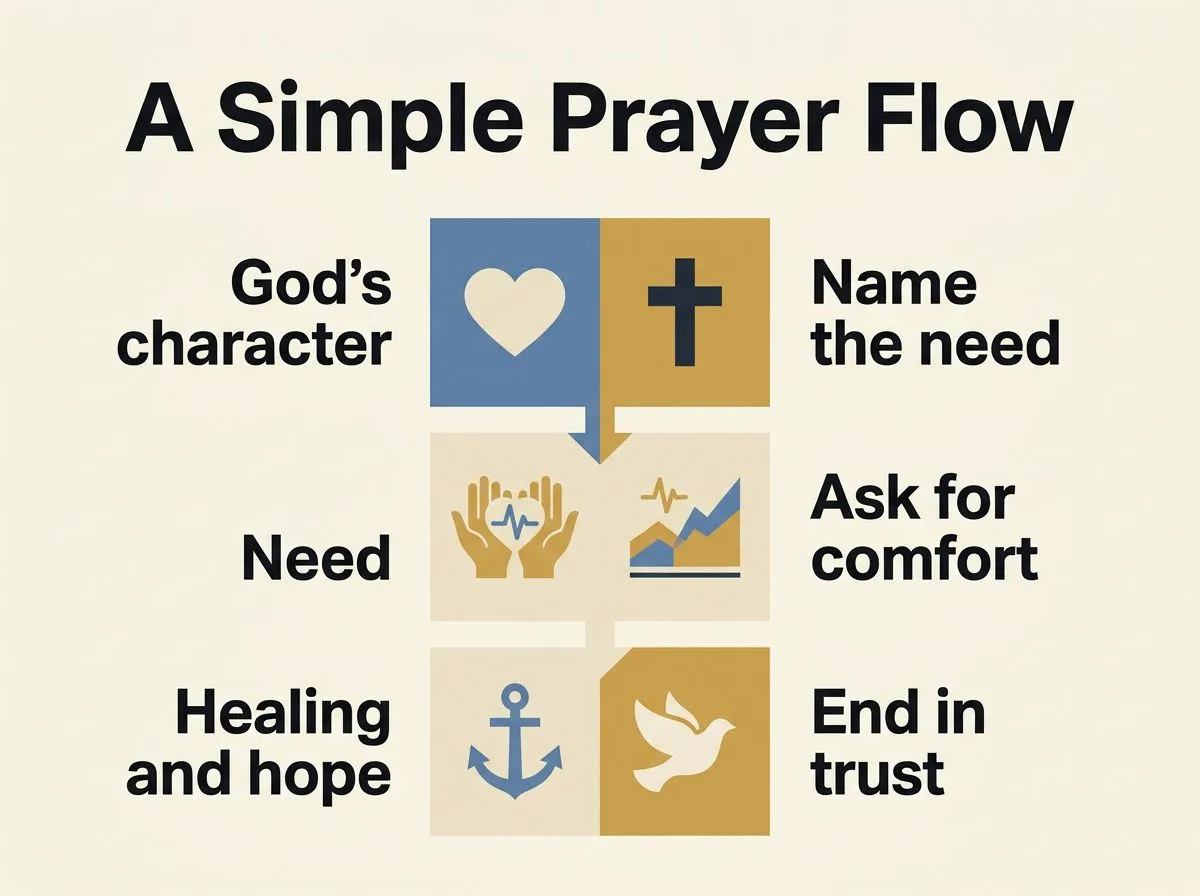
- Begin by honoring God’s character, His mercy, faithfulness, and power to heal.
- Name the need clearly, whether it is pain, weakness, fear, treatment, or uncertainty.
- Ask for comfort, healing, hope, strength, and peace using simple, direct words.
- Pray for wisdom for doctors, nurses, and caregivers, without replacing medical care.
- Close with trust in God’s will and in the name of Jesus.
This flow keeps the prayer grounded. It doesn’t pressure the sick person to sound strong, and it doesn’t turn prayer into a substitute for treatment. Pastors.com notes that illness can involve physical, chemical, or physiological realities, which means wise prayer can hold faith and medical care together. Pastors.com
How to tailor the wording for serious illness, chronic illness, and hospice
The same prayer sounds different depending on whether the need is urgent, long-term, or near the end of life. The table below shows how to choose language that fits the moment without losing hope.
| Situation | Best emphasis | Words to include | Words to avoid | Scripture fit | Pastoral care note |
|---|---|---|---|---|---|
| Serious illness | Urgent healing, protection, clarity, and peace in the middle of fear | “Lord, bring healing,” “steady the body,” “guide the doctors,” “give peace today” | Overly certain claims, pressure, or language that sounds demanding | Jeremiah 17:14, Psalm 30, Psalm 57 | Keep the prayer hopeful and grounded, and encourage practical medical support |
| Chronic illness | Daily strength, endurance, relief, and grace for the long road | “Give strength for today,” “help them endure,” “renew hope,” “carry them through” | Impatience, quick-fix wording, or making the person feel faith is being tested | Psalm 51, Psalm 57, and other comfort passages | Focus on faithful endurance and repeated prayer, not only immediate recovery |
| Hospice | Peace, comfort, dignity, presence, and trust in God’s care | “Surround them with peace,” “ease pain,” “hold them close,” “receive their spirit in Your love” | Pressure to recover, fear-driven language, or promises that dismiss the reality of end-of-life care | Psalm 23, Psalm 30, Psalm 57 | Pray gently, support the family, and keep the words tender and respectful |
A simple prayer you can pray right now
Lord Jesus, You see this sickness, and You know every hidden pain, fear, and weakness. Please bring healing where healing is needed, comfort where the heart is worn down, and peace that settles this moment with Your presence.

Give strength to the body, calm to the mind, and hope to the one who is suffering. Guide doctors, nurses, and caregivers with wisdom and care, and help every treatment do what it is meant to do. Hold this person in Your mercy and keep them close to You.
When fear rises, remind them that You are near. When pain lingers, be their refuge. When the future feels uncertain, give them courage to trust You one day at a time. In Jesus’ name, amen.
How to pray when you do not know the right words
A short prayer is enough when your heart feels overwhelmed. One sentence can carry real faith: “Lord, heal, comfort, and strengthen this person today.”
That kind of prayer works because it stays honest. Life.Church encourages believers to pray in straightforward language and to read Psalms like Psalm 30, Psalm 51, and Psalm 57 out loud, which gives your prayer a steady biblical shape. Life.Church
You can also pray with a name, a need, and a promise. For example: “Father, please bless Maria with rest after surgery, calm her fear, and let Your peace guard her tonight.” Simple words often carry the most trust.
What to pray for the family and caregivers
The family around a sick person needs prayer for stamina, patience, and peace too. Sickness rarely touches only one person, because caregiving changes schedules, sleep, emotions, and decisions all at once.
Catholic Charities USA’s prayer for the sick asks God to strengthen family members, guide doctors and nurses, ease fear, and give hope to those in pain. That pattern is helpful because it reminds you to pray beyond the patient and include the people holding the room together. Catholic Charities USA
You can say, “Lord, strengthen the family, steady the caregiver, and give everyone in this home rest for today.” That keeps the prayer human and practical. It also helps prevent the quiet exhaustion that often builds when someone is sick for more than a few days.
Where Scripture gives your prayer more depth
Scripture gives your prayer a voice when your own words feel thin. Jeremiah 17:14 is especially direct, because it asks for healing and rescue in a way that is plain and trusting.
The Psalms give a wider range of language for sickness. Psalm 30 helps when you need thanksgiving and recovery, Psalm 51 helps when the heart feels burdened and needs mercy, and Psalm 57 helps when fear is close and you need refuge. Church Society and Biblical Training both point readers toward prayer that includes healing, courage, and care for those who are sick, which fits a bedside prayer well. Church Society
If you want one practical habit, read one short Psalm before you pray and borrow one phrase from it. That keeps your prayer anchored in God’s Word without turning it into a memorized script.
When to keep the prayer brief and when to linger
A brief prayer is best when the room is tense, the person is tired, or you’re praying in public. In those moments, one calm request for healing and peace can be more loving than a long speech.
Linger longer when the person asks you to stay, when the situation is serious, or when you’re praying with close family. Justice & Mercy International describes pastoral care as the steady work of visits, counseling, and presence, which is a good reminder that prayer sometimes needs time, not performance. Justice & Mercy International
If the person is in pain, start with comfort. If they are afraid, start with peace. If they are exhausted, keep the prayer short and repeat it gently instead of adding more words.
A practical way to pray with compassion and truth
The best prayer for a sick person is one that sounds like love, not pressure. It asks God for healing while also honoring the reality of treatment, weakness, and waiting.
Biblical Training’s teaching on pastoral care notes that sickness can bring solitude, and Church Society’s prayers keep healing and courage in view. That matters because sick people often need more than a request for a miracle, they need reassurance that they are seen, held, and not forgotten. Biblical Training
You don’t need polished wording. You need honest faith, gentle words, and the courage to ask God for what matters most right now.
Verification checklist
- Read the prayer aloud once, and it must clearly name healing, comfort, strength, and peace.
- Check the wording for the situation, and it must fit serious illness, chronic illness, or hospice without sounding forced.
- Include one brief request for doctors or caregivers, and it must support medical care rather than replace it.
- Use at least one Scripture reference in the final prayer, and it must fit the moment you are praying for.
- End with trust in Jesus, and the closing must sound calm, specific, and sincere.
Frequently asked questions
Can I pray for healing even if the doctor has already given a diagnosis?
Yes. Prayer and medical care can go together, even after a diagnosis is known. A good prayer can ask God for healing, peace, and wisdom for doctors, nurses, and caregivers, while still honoring the treatment the person is receiving.
Should I pray out loud with the sick person or pray privately?
Either is fine, but the setting matters. Pray out loud if your words would comfort them, and keep it quiet if they need rest, privacy, or are too tired to engage. In a tense room or bedside setting, a short, calm prayer is often the kindest choice.
What if I do not know the person’s faith background?
Keep the prayer gentle, respectful, and simple, and focus on comfort, strength, and peace unless they invite more specific Christian language. If you need a safe starting point, ask God for healing, rest, and mercy in plain words that do not pressure the person to respond a certain way.
How long should a sick-person prayer be?
It can be one sentence or several minutes. The point is sincerity, not length, and a brief prayer is often best when the person is in pain, exhausted, or the room is public. If the person asks you to stay or the situation is serious, you can linger a little longer.


A Powerful Prayer for a Secure and Successful Future
A powerful prayer for a secure and successful future can bring peace when tomorrow feels uncertain. Questions about your family, career, finances, health, and…

A Powerful Prayer for Your Children’s Education and Future
A powerful prayer for your children’s education and future can help you place their learning, decisions, dreams, and challenges in God’s loving hands. Parents…

A Powerful Prayer for Anxiety, Stress, and Peace of Mind
A powerful prayer for anxiety, stress, and peace of mind can help you turn to God when your thoughts feel overwhelming and your heart cannot find rest. In mome…

A Powerful Prayer for Guidance When You Feel Lost
When uncertainty clouds your thoughts and every path seems confusing, a powerful prayer for guidance when you feel lost can help you slow down, seek God’s pres…