
Is Revelation Literal or Symbolic? Understanding the Book of Revelation
Revelation is literal in the sense that John wrote a real message to real churches, but a lot of its language is symbolic, vivid, and shaped by the Bible’s prophetic imagination. If you read it as a coded newspaper, or as a free-floating poem, you miss the point. The book was written to strengthen faith, not to fuel speculation.
Key takeaways
- Revelation is a letter, prophecy, and apocalyptic book, so its meaning depends on all 3 forms, not just one.
- The 4 major Christian readings are futurist, historicist, preterist, and idealist, and each shapes Revelation 20 differently.
- Numbers like 42, 666, 1,000, and 144,000 can be read differently, so the debate often turns on consistency, not just preference.
- A symbol in Revelation still points to something concrete, so the question is not whether imagery matters, but what it represents.
- Read Revelation to strengthen endurance now, not to build a date chart for the end times.
What kind of book Revelation is, and why that matters
Revelation is a letter, a prophecy, and an apocalyptic book all at once, and that three-part shape controls how you read it. John writes from Patmos to the Seven Churches of Asia, so the book starts as pastoral communication to believers facing pressure, compromise, and fear. That setting keeps the visions tied to real discipleship, not abstract puzzle-solving.
The apocalyptic style matters because it speaks in symbols that reveal hidden spiritual realities through dramatic images. That does not make the book unreal, it makes it interpretively dense. Revelation uses beasts, seals, numbers, worship scenes, and a final city because ordinary prose would not carry the same force. The symbol points beyond itself, but it still means something concrete.
The first-century setting matters, too. Christians in the Roman world had real reasons to feel the strain of empire, loyalty tests, and social pressure to fit in. Revelation answers that pressure with a different center of gravity: Christ reigns, evil will be judged, and God will finish what He started. That is why the book sounds severe and hopeful at the same time.
If you want the shortest honest summary, it is this: Revelation is not a secret code for the curious, it is a call to endurance for the faithful. Renew.org says that plainly by teaching us what we are in, that we win, and how we win. That is the right starting point because it puts obedience ahead of guesswork.
The four major ways Christians read Revelation
| Interpretive approach | Main idea | Revelation 20 and the millennium | Seven seals and the 144,000 in Revelation 7 | Practical effect on how the book unfolds |
|---|---|---|---|---|
| Futurist | Most of Revelation points to future end-time events, especially the period leading up to Christ’s return. | Revelation 20 is usually read as a real future millennium after Christ’s return. | The seven seals and the 144,000 are often treated as future events or future people with direct prophetic fulfillment. | Readers expect the book to move in a largely forward-looking sequence. |
| Historicist | Revelation maps major movements of church history from John’s day to the present. | Revelation 20 may be read as a symbolic era within the flow of history or as a future kingdom depending on the interpreter. | The seven seals and the 144,000 are often linked to stages or groups across Christian history. | Readers look for long-range historical correspondence rather than one tight end-times timetable. |
| Preterist | Most of Revelation was fulfilled in the first century, especially in events surrounding the fall of Jerusalem or Rome. | Revelation 20 is commonly read symbolically or as already fulfilled in a spiritual sense. | The seven seals and the 144,000 are often treated as symbols tied to the original audience’s crisis. | Readers focus on what the book meant then, with less emphasis on a future chronology. |
| Idealist | Revelation portrays the recurring conflict between Christ and evil throughout the church age. | Revelation 20 is read as a symbolic picture of Christ’s reign and Satan’s restraint, not necessarily a literal thousand-year era. | The seven seals and the 144,000 are treated as symbolic pictures of judgment and God’s preserved people. | Readers expect the book to reveal patterns that repeat across the whole age of the church. |
These four views do not all handle numbers the same way, and that difference is a major fault line.
In the futurist view, Revelation 20 is usually read as a future millennium and Revelation 7 as a future sealing of 144,000 Jews; the preterist often ties much of the book to the first century, such as Jerusalem’s fall in A.D. 70; the historicist reads Revelation as a sweeping map of church history; and the idealist treats 7 and 20 as symbolic pictures of spiritual conflict and final victory.
Spirit and Truth notes that preterists can treat some numbers, such as 42 or 666, more literally while treating 1,000 or 144,000 as symbolic, which shows why the debate is often about consistency as much as interpretation.
The practical consequence is simple: your view of the numbers shapes your expectations for the whole book, especially in Revelation 7 and 20.
Among evangelical teaching resources, GotQuestions.org, Olive Tree Blog, PreceptAustin.org, and David Jeremiah Blog all point readers toward these major interpretive lanes, even when they favor different ones. That helps, because it tells you the debate is not between Bible readers and skeptics. It is between Christians trying to explain how apocalyptic prophecy works.
Where the debate comes from: the passages that drive interpretation
- Revelation 20 and the millennium, especially the question of how to understand Satan being bound and the thousand years. Futurist readers usually expect a future kingdom; idealists often see a symbolic picture of Christ’s reign now; preterists commonly read it as fulfilled or spiritually fulfilled; historicists tend to place it within the sweep of church history.
- Revelation 7 and the 144,000, including whether the number is symbolic, literal, or both in a theological sense. Some read it as a fixed group from Israel, others as a symbol of God’s sealed people, and still others as a first-century or end-times reference depending on their broader system.
- The seven seals, trumpets, and bowls, with the question of sequence versus overlap. A sequential reading treats these as a chain of events, while a cyclical reading sees them as repeated visions describing the same era from different angles.
- The beast, the dragon, and the New Jerusalem, because these images force readers to decide whether Revelation is mainly about Rome, recurring evil powers, the final defeat of Satan, or the literal renewal of creation.
These passages matter because they are where the book stops feeling abstract. Revelation 20 decides what you think history is moving toward. Revelation 7 decides whether the 144,000 is a census, a symbol, or both in theological meaning, and that changes whether you read the chapter as a literal count, a representative people, or a picture of God’s preserving power. The seals and bowls decide whether John is moving in a straight line or circling back with increasing intensity.
That is also why readers often land in different places without becoming careless. They are not all ignoring the text. They are making different decisions about how images work, how Old Testament echoes function, and how much sequence the book demands.
How to tell symbolic imagery from literal detail in Revelation
You can tell symbolic imagery from literal detail in Revelation by checking whether the text itself, the Old Testament background, and the whole book point toward a figure of speech rather than a plain object. That means you start with the image, then look for the Bible’s own interpretive clues. Revelation often gives them if you slow down long enough to notice.
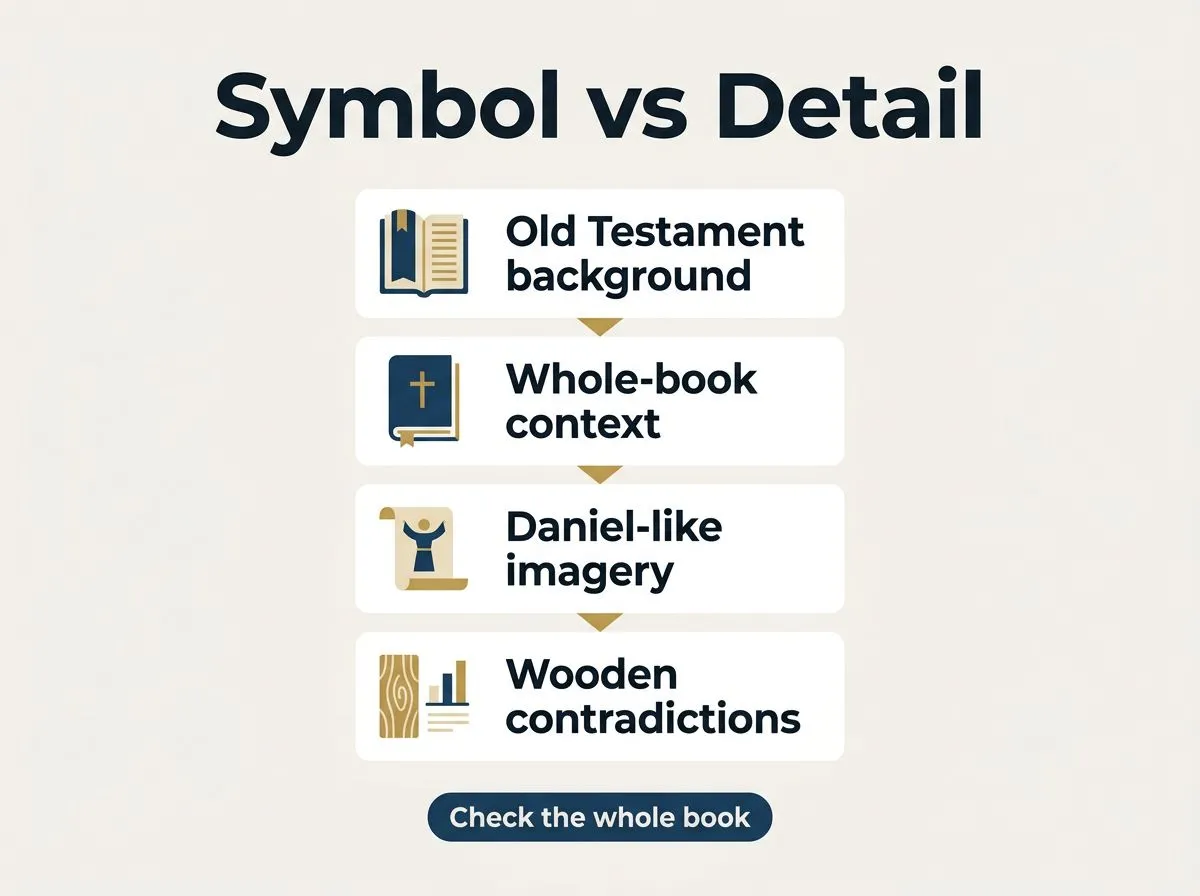
Step 1: Look for Old Testament echoes
If an image sounds like Daniel, Ezekiel, Zechariah, or Exodus, it is probably doing more than describing a scene. A beast with horns, a sealed people, and a city of glory all draw on earlier Scripture. The beginner’s mistake is to treat the image as if John invented it from scratch, when he is often reusing biblical language on purpose.
Step 2: Ask whether a literal reading breaks the passage
If taking the image woodenly creates contradictions or flattens the book’s message, the symbol is probably carrying the meaning. The 144,000 in Revelation 7 is the clearest example of why this question matters, because the text presents a numbered, sealed people in a way that invites theological reading, not mere counting. Spirit and Truth and PreceptAustin.org both show how differently Christians handle that number, which is a reminder to avoid forcing one system onto every image.
Step 3: Let the text explain itself where it can
Revelation is safest to interpret where it interprets itself. When John explains a lampstand, a horn, a crown, or a heavenly scene, you should treat that explanation as the anchor, not as a decorative note. That discipline keeps you from building doctrine on speculation and keeps the reader close to the book’s own grammar.
Step 4: Read the book for worship and endurance
Revelation’s main pastoral purpose is to steady believers who need courage, not to satisfy people who want a date chart. That is why Renew.org and David Jeremiah Blog both stress Christ’s victory and the blessing of keeping the words of the prophecy. When you read Revelation that way, the symbolism becomes a means of hope, not a trapdoor into endless speculation.
A helpful rule is to move from the clear to the unclear. Start with the repeated claims that Christ reigns, God judges evil, and the church is called to endure. Then let those clear themes guide the harder images. That keeps the book from turning into a guessing game about current events.
So is Revelation literal or symbolic?
Revelation is both literal and symbolic, but not in the same way in every verse. Its letters went to real churches, its warnings called for real obedience, and its final hope points to real judgment and real renewal. At the same time, its beasts, numbers, seals, and city imagery are often symbolic, because that is how apocalyptic prophecy communicates truth.
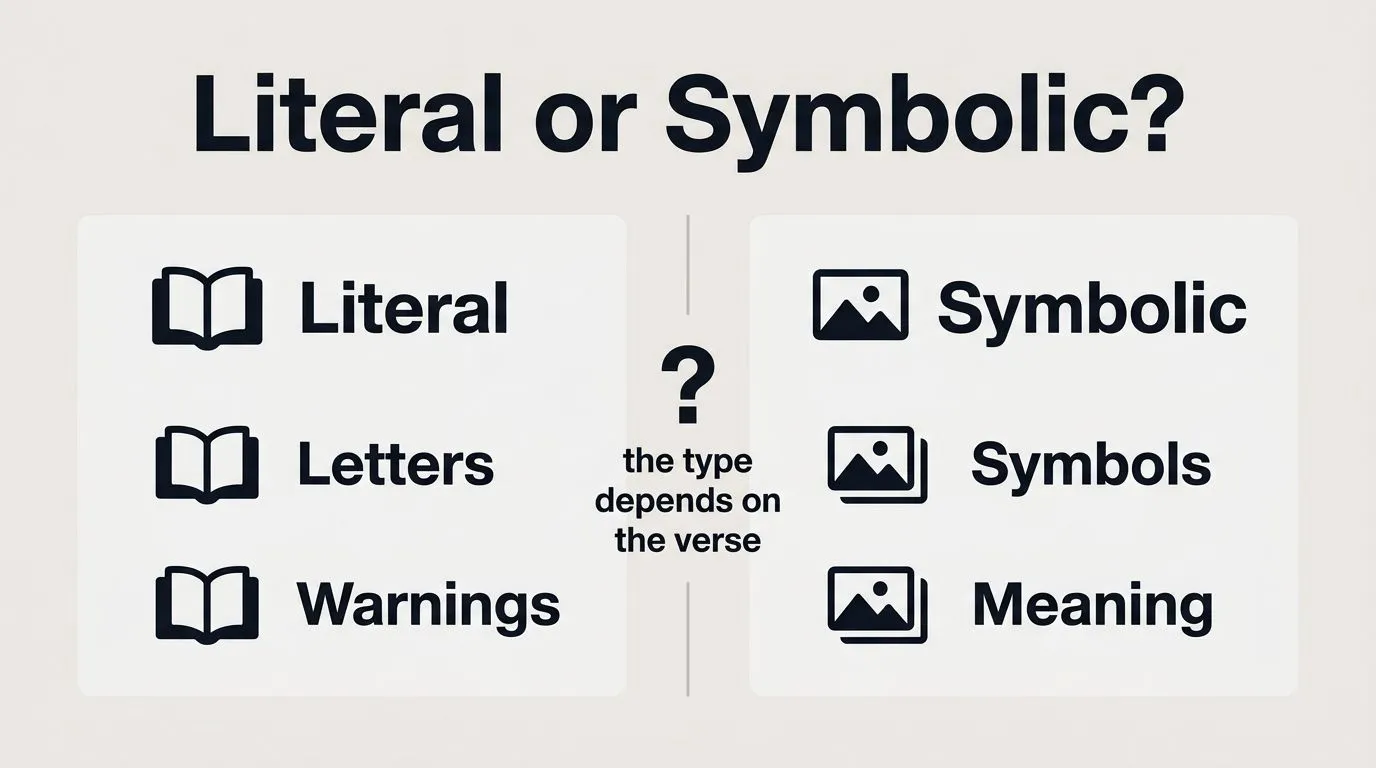
That means a wise reader does not force one single rule onto the whole book. The better question is not, “Is Revelation literal or symbolic?” The better question is, “What kind of language is John using here, and what does the text itself tell me to do with it?” Ask that honestly, and Revelation becomes clearer, not smaller.
The safest reading is the one that keeps Christ at the center, respects the book’s first audience, and lets symbols speak without letting speculation take over. Read it as Scripture for the church, not as a codebook for the curious. That is how the visions keep their force and their comfort, even when the details stay difficult.
Frequently asked questions
Is Revelation meant to predict exact future events?
Some Christians read it that way, especially in futurist interpretations, but not every major approach treats every vision as a future timetable. The article says Revelation can also be read as already fulfilled, ongoing, or still ahead, so the key is to ask how a passage fits the larger view of the book.
Does the number 144,000 have to mean exactly 144,000 people?
Not necessarily. In Revelation 7, some Christians read the 144,000 as a symbolic number tied to God’s sealed people, while others take it more literally as a defined group, often connected to Israel. The article’s point is that the context of Revelation 7 drives the debate, not the number by itself.
Why do so many Christians disagree about Revelation?
Because Revelation uses apocalyptic imagery, Old Testament echoes, and visions that can be read historically, symbolically, or futuristically. The article adds that the disagreement often starts with method, especially how readers handle numbers, sequence, and symbolic language, before it reaches any single verse.
Should a beginner read Revelation with a commentary?
Yes, if possible. A good commentary can help you notice genre, context, and repeated symbols so you do not read the visions as isolated puzzles. It is especially helpful when you are trying to tell whether an image is meant to be taken literally or symbolically in its setting.


A Letter From Jesus to You
Maybe you arrived here carrying thoughts that no one else knows about. Maybe everything seems fine on the outside, but inside, a battle is taking place. There…

Jesus Has a Word for Your Heart Today
Maybe you arrived here carrying thoughts that no one else knows about. It could be a concern about your family, an important decision, a financial struggle, or…

7 Promises From God for Difficult Times
Seven promises to pray in hard seasons, with clear context so you can trust God’s Word without misreading it.

A Practical Guide to Reading the Gospels
Read one Gospel at a time, keep sessions short, and notice each writer’s purpose so Jesus’ words stay clear.